
Clinically reviewed by the Peachtree Detox & Residential clinical team · November 2026
In Florida, a drinking or drug problem can blend right into beach-town life. A server in Destin who drinks through the off-season because the summer money ran out. A lineman in Jacksonville who kept the pain pills going long after the shoulder healed. A Florida State student who swore the pills from a friend were Xanax, and was lucky that night. The people who love them usually notice before anyone says it out loud: the car parked crooked, the phone that goes unanswered until noon, the shaky hand reaching for the coffee. If something like that brought you here, those signs are worth taking seriously.
Peachtree Detox & Residential treats adults with substance use disorder at 1008 GA-54 in Fayetteville, Georgia, about a half hour south of Hartsfield-Jackson Atlanta International Airport. We do not have a Florida location. What Florida families find here is medically supervised drug and alcohol detox followed by a residential stay on the same campus, with one team carrying a person from the first night through the weeks after. Florida joins the other states across the Southeast that we serve, and the questions people ask from there tend to be the same: how far, how safe, and how it gets paid for.
Begin Atlanta Detox and Residential Treatment Today
Peachtree Detox & Residential is a premier provider of addiction treatment services and detox programs in Georgia. If you or someone you love is in need of professional care, reach out to us now.
Why Some Florida Families Look North to Georgia
Florida has a large treatment system, and for many people the right program is a short drive from home. When Florida families do look out of state, there is usually one concrete reason behind it. Some want detox and residential care under one roof, so the last day of withdrawal runs straight into the first week of therapy. Some have watched three attempts fall apart at home in Gulf Breeze or Orange Park, each one ending at the same friend’s place or the same corner store. Others live in North Florida, where Atlanta is simply closer than Tampa, Orlando, or Miami.
Access is part of it too. Florida’s Department of Children and Families explains that the state organizes publicly funded behavioral health care through regional managing entities, and that the services available in an area are limited by the funding available there. In practice, that can mean waiting lists, especially for a bed at the level of care a person actually needs.
Distance helps in a more practical way too. The routines that kept use going live at home: the drive past the bar on Tennessee Street, the coworker who always has something, the bottle in the garage fridge. Fayetteville is four to six hours from all of that. A drive that long makes walking out on a bad night much harder to carry out, though never impossible, and that buys the body time to settle and the craving time to ease.
Getting to Fayetteville From Across Florida
Fayetteville sits in Fayette County, south of Atlanta and between I-85 and I-75, so most of North Florida reaches us without ever entering downtown traffic. These drive times are rough guides, and holiday traffic on I-75 can add an hour or more.
- Tallahassee and the Big Bend: About four and a half hours. Head north on US-319 through Thomasville and Moultrie to I-75 at Tifton, then up through Macon to the south side of the metro and west to Fayetteville.
- Pensacola, Fort Walton Beach, and Panama City: About five hours. From the western Panhandle, most drivers go up through Montgomery and pick up I-85 toward Atlanta, leaving near Newnan and coming across through Peachtree City on GA-54. From Panama City, the drive starts north on US-231 through Dothan.
- Jacksonville and the First Coast: About five and a half hours, either I-10 west to I-75 at Lake City or I-95 north to I-16 and Macon.
- Lake City, Gainesville, and Ocala: Roughly four and a half to five and a half hours, almost all of it on I-75 through Valdosta and Tifton.
- Tampa, Orlando, and South Florida: Close to seven hours or more by car, which is why most families from the peninsula fly.
Flying in from Florida
Hartsfield-Jackson sits on the south side of the metro, the same side we do. Flights from Florida’s larger airports are short, and from the terminal it is roughly 30 minutes south to our door on GA-54, with Piedmont Fayette Hospital a few minutes up the road. Many families have one person fly up with their loved one and the rest of the household stay home, which keeps the arrival calm.
Tour Our Detox & Residential Rehab Programs Near Atlanta, Georgia
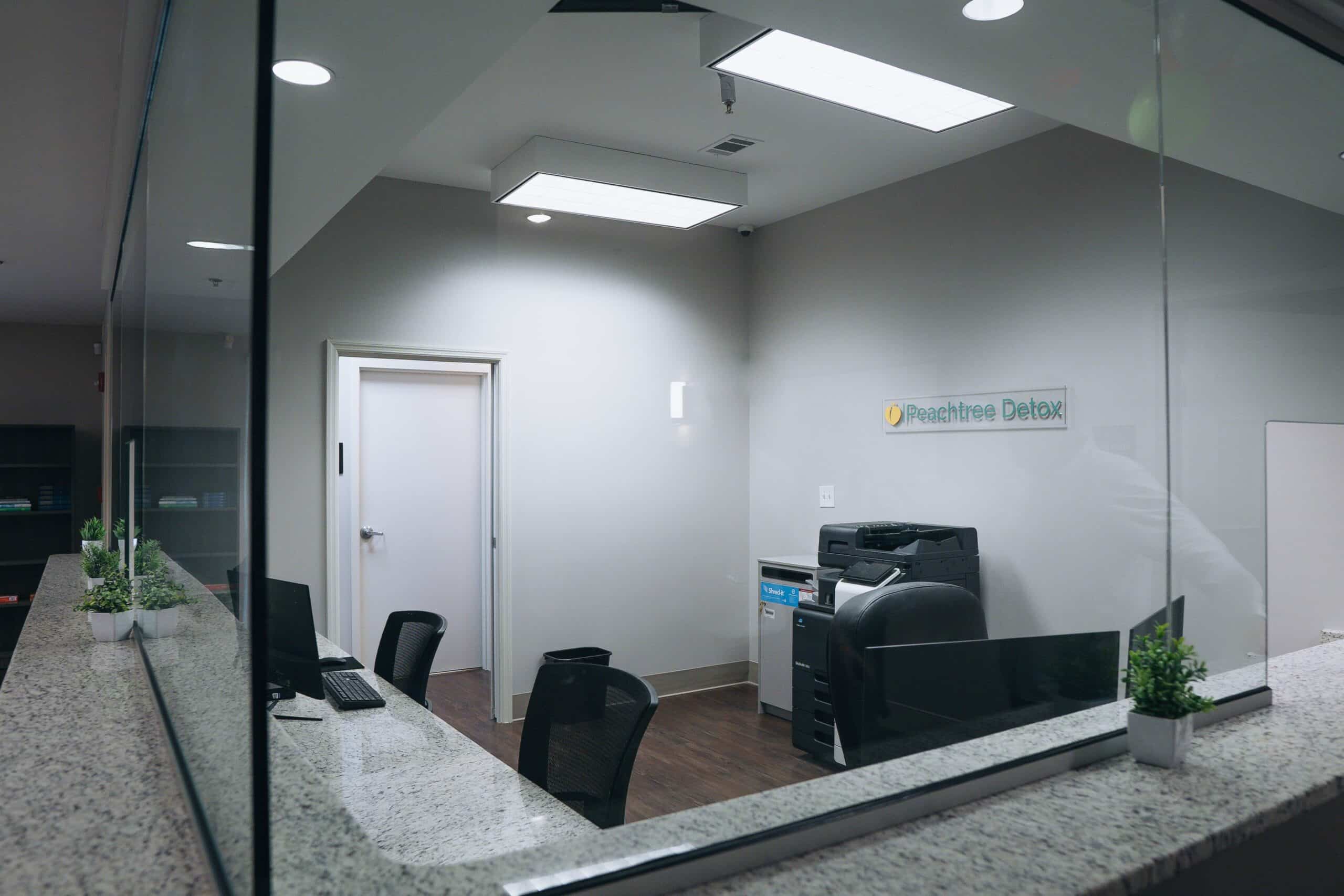
What Detox and Residential Care Look Like Here
Coming off a substance is a medical event, and the risk depends on what a person has been using. Detox is a recognized level of care in the ASAM Criteria, the framework clinicians use to match a person to the right intensity of treatment, and residential care is a separate step that follows it. Here is what we see most often from Florida, and why each one belongs somewhere supervised:
Alcohol
After heavy daily drinking, withdrawal symptoms usually start within about eight hours of the last drink and tend to peak between 24 and 72 hours, according to MedlinePlus. Severe cases can bring seizures or delirium tremens, a dangerous state of sudden confusion, which is why our alcohol detox happens with nurses checking vital signs through the night.
Fentanyl and Other Opioids
NIDA notes that as little as two milligrams of fentanyl, about the size of a few grains of salt, can be fatal, and that it turns up in counterfeit pills. Withdrawal is miserable rather than usually deadly, but returning to an old dose after a few days off is when overdoses happen. Our fentanyl detox program treats symptoms as they come.
Benzodiazepines
Xanax, Klonopin, and Ativan are tapered slowly under supervision, because stopping them suddenly can cause seizures.
More Than One Substance
Alcohol with pills, or stimulants with opioids, is common, and it is the picture that most needs a medical team watching how the pieces interact.
For opioid use disorder, medication-assisted treatment is available here too. We offer Suboxone and the monthly Sublocade injection, both forms of buprenorphine, which settle withdrawal and cravings, as well as Vivitrol and oral naltrexone, which block opioids from taking effect. SAMHSA lists these among the FDA-approved medications for opioid use disorder. Whether any of them fits is a decision our medical team makes with each person.
After detox, the work moves into our residential treatment program. Each person has weekly individual therapy with a master’s-level therapist. Groups draw on cognitive behavioral therapy, which helps people catch the thoughts that tend to come right before using, and dialectical behavior therapy, which teaches ways to ride out strong emotions without acting on them. Trauma-informed therapy, holistic therapy, and trauma-informed yoga round out the week, along with AA, NA, and SMART Recovery meetings.
Florida’s Marchman Act and the Conversation Before It
Many Florida families have heard of the Marchman Act, often from a friend who used it. The Department of Children and Families describes it as the state law that provides for voluntary admissions and for involuntary assessment, stabilization, and treatment of adults and youth who are severely impaired by substance use. It is a Florida legal process, filed in Florida courts, and it has its own forms and rules.
It is also a heavy step, and many families reach it only after every conversation at the kitchen table has gone badly. If you are somewhere short of that point, a call with our admissions team can help you sort out what is actually happening and what a voluntary admission would involve. That call does not replace legal advice. It can make the next conversation with your loved one a little more concrete.
Staying Connected, and the Trip Back to Florida
The family back in Florida usually feels the distance first. Peachtree Detox & Residential has a nightly phone policy, so a mother in Niceville or a husband in Mandarin can hear their person’s voice each evening instead of waiting weeks for a first call. Family therapy gives relatives a structured way to take part, even from out of state.
Before discharge, our team builds an aftercare plan aimed at outpatient care, medication follow-up, and meetings close to home, whether home is Leon County or Duval. The aim is for the first week home to have appointments already on the calendar. It also helps to keep naloxone in the house once someone returns, since tolerance falls during treatment and an old dose can become a dangerous one.
Insurance for Florida Residents
Peachtree Detox & Residential accepts many insurance plans, and for military families and retirees around Pensacola, Jacksonville, and the Panhandle bases, that includes TRICARE East Select and Prime.
For any other plan, the answer depends on the details of the policy, and a plan written in Florida can treat an out-of-state program differently from one down the street. Start with a confidential insurance check, and our admissions team will go through your benefits with you, including any out-of-state rules, before anyone books a flight. Private-pay arrangements are available as well, with the costs laid out up front.
From Florida to Fayetteville
Most first calls from Florida come from someone a few steps removed: a sister in Tallahassee, a dad who has been on the phone with three programs already, a partner who finally said the word out loud. Any of those is a fine place to start, whether the call is for yourself or for someone you love. Use the Peachtree Detox & Residential admissions page to reach our team. Expect questions about what has been going on, a look at your coverage, and a straight description of the trip north and the first night here. Ask as much as you want; nobody will push you toward a decision on that call. If someone is not breathing or cannot be woken, call 911 first.
Frequently Asked Questions About Detox and Residential Treatment for Florida Residents in Faytetteville, GA
No. Our only campus is at 1008 GA-54 in Fayetteville, Georgia, south of Atlanta. Florida residents come to us by car, usually up I-75 or through Montgomery on I-85, or by flying into Hartsfield-Jackson, which is about a half hour from campus. Our admissions team can also help you weigh the trip against programs closer to home.
From Tallahassee, plan on about four and a half hours. Pensacola or Panama City, about five. From Jacksonville or Gainesville, roughly five to five and a half. Families from Tampa, Orlando, and South Florida usually fly, since the drive runs close to seven hours or more and the flight into Atlanta is short.
Many plans do, but coverage depends on the details of your policy, including how it handles care outside Florida. Our admissions team will run a confidential benefits check and explain what your plan covers before you travel. Private-pay options are also available.
Sources
- Georgia Department of Behavioral Health and Developmental Disabilities. (2024). Behavioral health services. Retrieved from: https://dbhdd.georgia.gov/. Accessed on November 26, 2026.
- National Institute on Alcohol Abuse and Alcoholism. (2024). Alcohol facts and statistics. Retrieved from: https://www.niaaa.nih.gov/alcohols-effects-health/alcohol-topics/alcohol-facts-and-statistics. Accessed on November 26, 2026.
- National Institute on Drug Abuse. (2024). Advancing addiction science. Retrieved from: http://nida.nih.gov/publications/drugs-brains-behavior-science-addiction/advancing-addiction-science-practical-solutions. Accessed on November 26, 2026.
- Substance Abuse and Mental Health Services Administration. (2024). FindTreatment.gov. Retrieved from: https://findtreatment.gov/. Accessed on November 26, 2026.