

Clinically reviewed by the Peachtree Detox & Residential clinical team · August 2026
Peachtree Detox & Residential is in Fayetteville, Georgia, not Fayetteville, North Carolina. The two towns share a name and very little else. For some Carolina households, the nearest option and the right one are not the same address, and the gap between them is a tank of gas on an interstate they already know by heart.
North Carolina is really three states wearing one name. The mountain counties along the Blue Ridge, the Piedmont cities strung down I-85, and the flat pine country that runs out to the water do not share weather, work, or much of anything else. What they do share is the hour this particular search tends to happen. It is late, the house has finally gone quiet, and whoever is typing has already tried the reasonable things.
We run a single program, and its address is 1008 GA-54 in Fayetteville, Georgia, roughly half an hour below the Hartsfield-Jackson runways in the southern half of the Atlanta metro. Peachtree Detox & Residential holds no beds in North Carolina and has no affiliated site there. The people we treat from your state chose to make the trip, usually because three things pointed the same direction at once: the intensity of care the situation actually called for, what a particular plan would pay toward it, and how quickly somebody could be seen.
Those calls come from Charlotte and Concord, from Durham and Cary, from Hickory and Winston-Salem, and from towns off US-64 that never make anyone’s map. They arrive wanting what brings families in from the Georgia towns across the communities we already serve: a medically supervised detox from drugs and alcohol, staffed by nurses overnight, and then a residential stay where the slower work begins. The trip is longer from Raleigh than from Newnan. The care waiting at the end of it is identical.
Three North Carolinas, One Drive South
Before a single clinical decision gets made, somebody has to answer a very unromantic question: how far is it, and who is driving. That question is allowed to come first. For most people it does.
From Charlotte, this is close to a one-road trip. I-85 leaves the Queen City southwest through Gastonia, crosses into South Carolina past Spartanburg and Greenville, and does not really let go until it hands you to Atlanta. Figure about four and a half hours door to door. on the front end from Greensboro or Winston-Salem. The Triangle is the long haul of the Piedmont: from Raleigh, Durham, or Chapel Hill you pick up I-85 at Durham or Greensboro and run roughly six hours total.
The mountains are closer than most people in Raleigh believe. Asheville sits nearer to Atlanta than the state capital does, whether you drop down I-26 to Spartanburg and turn onto I-85 or take the two-lane run through the Nantahala on US-23 and US-441. Either way it is about four hours.
From the coast, where I-40 finally quits at Wilmington, the drive stretches past six and a half, so families in Wilmington, Jacksonville, and the little towns behind the Outer Banks more often look at a plane. Charlotte Douglas and RDU both feed Atlanta all day long, and the flight itself runs a little over an hour. Hartsfield-Jackson happens to sit below the city rather than above it, which puts the terminal and our building on the same end of the map. Nobody arriving has to cross the Connector or take on north-side traffic. It is a straight half hour from baggage claim to GA-54.
Fayetteville, Georgia, is a courthouse-square county seat rather than a city. Tyrone and Peachtree City are the neighbors, Piedmont Fayette Hospital is a few minutes up the road, and there is a clinical argument hiding inside all that mileage. Getting through the first week of withdrawal in the same bedroom, on the same street, with the same three numbers still in the phone means every old cue gets a vote. Several hundred miles does not fix anything by itself. It does quiet the vote long enough for medicine and sleep to do their part.
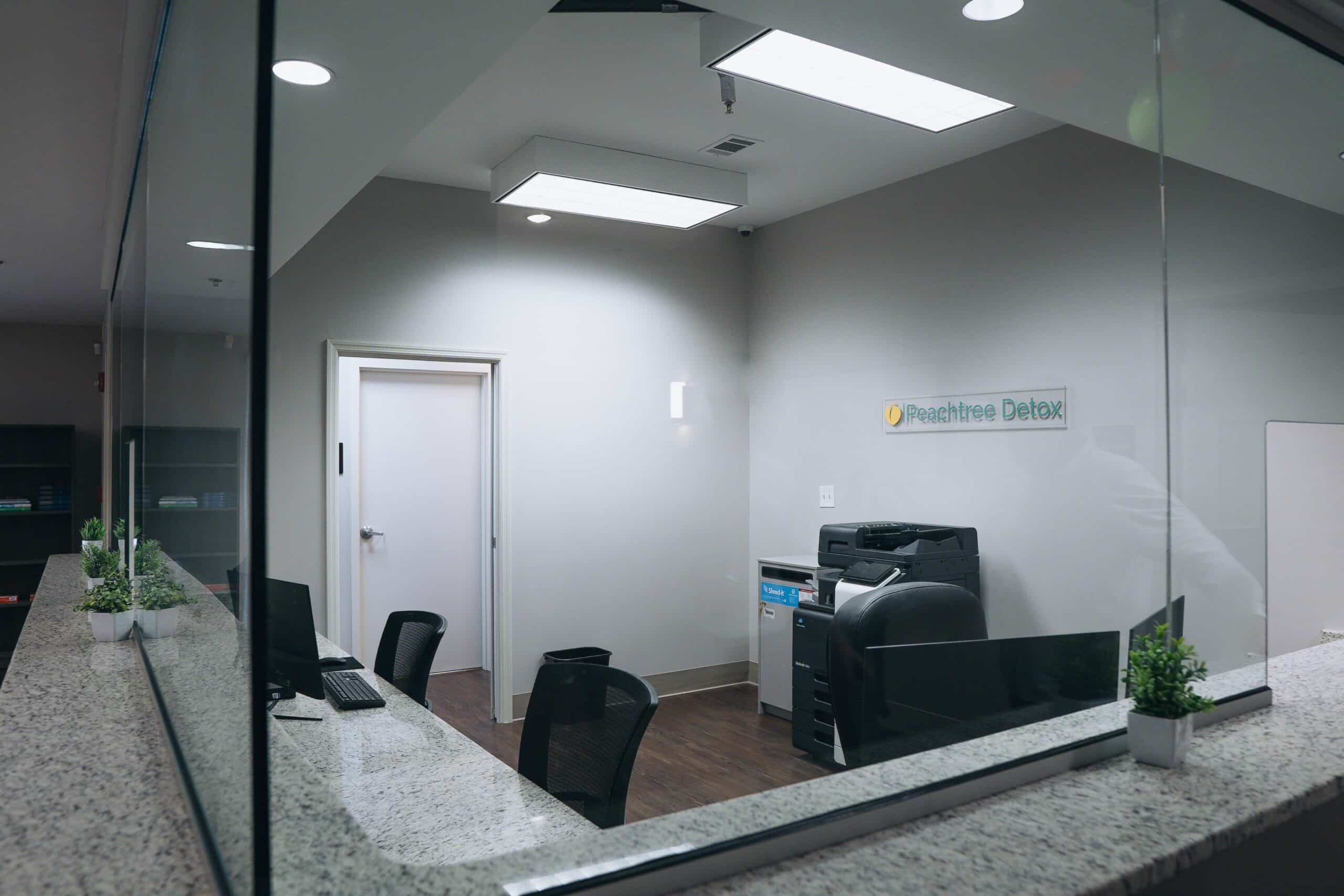
Tour Our Detox in Atlanta, Georgia


What Finding a Detox Bed Looks Like in North Carolina
If the last two weeks have been spent on hold, handed from one number to the next while the person you are calling about paces the kitchen, that is not evidence you went about it wrong. North Carolina organizes this differently than most states do, and the system is genuinely hard to read from the outside.
Publicly funded behavioral health care here runs through LME-MCOs, short for Local Management Entities and Managed Care Organizations. These are regional bodies that coordinate mental health, substance use, and developmental disability services, and which one handles your care depends entirely on which county you live in. The state also funds mobile crisis teams that will come to a person rather than making them come in, along with open-access walk-in clinics for same-day support, according to the North Carolina Department of Health and Human Services. Those are real resources, and for plenty of families the right answer is a program 40 minutes from their own driveway.
For a household carrying commercial insurance or Tricare, though, the public system is a parallel track rather than the one they are on. The question shifts to what the plan actually covers at this level of care and where those benefits work, and that is the point at which state lines stop meaning much.
It is also worth saying plainly that western North Carolina is still rebuilding. Communities across the mountains have been putting themselves back together since Hurricane Helene, and the state continues to run dedicated recovery support for people there. When local capacity is stretched thin for reasons that have nothing to do with anyone’s addiction, looking outside the region is not giving up on home. Knowing what detox actually costs before you call anyone tends to make the next conversation shorter.
The Withdrawals That Are Not Safe to Ride Out at Home
Most families do not call on the worst night. They call two or three days after it, once the shaking has stopped, the apology has been made, and everybody in the house has agreed out loud that it cannot happen like that again. That gap is where good decisions actually get made.
The scale of what North Carolina is carrying is not in question. State health data show that from 2000 through 2024, more than 44,500 North Carolinians died of a drug overdose, and that in 2024 alone the state lost eight people a day. Overdose is the number everyone quotes, but it is not the only way this turns fatal. For certain substances the danger arrives when a person stops, which is exactly backward from what most people expect and exactly why supervised detox exists as its own level of care.
Dangers of Alcohol Withdrawal
Alcohol is the clearest example and the one families are quickest to wave off. Someone can drink hard for a decade, hold a management job in Charlotte, coach a team in Apex, and look fine on a Tuesday. NIAAA, the federal institute for alcohol research, classifies alcohol use disorder as a medical condition rather than a character problem. Quitting cold after years of heavy drinking can set off seizures, and in a smaller share of cases it escalates into delirium tremens, often shortened to DTs, when the systems that hold heart rate, blood pressure, and body temperature steady simply quit doing it. Left untreated, that escalation kills people. Peachtree Detox & Residential provides medically supervised withdrawal for:
- Alcohol: the withdrawal most often described as something to tough out, where medical alcohol detox lowers seizure risk rather than merely taking the edge off.
- Benzodiazepines: Xanax, Klonopin, and Ativan, where a supervised benzodiazepine taper steps the dose down in stages, because stopping these abruptly carries a genuine seizure risk of its own.
- Opioids, fentanyl included: seldom deadly by itself, though the hour-by-hour arc of opioid withdrawal gets bad enough that people return to what they know, at a strength their body has quietly stopped tolerating.
- Stimulants: cocaine and methamphetamine, where the hardest part shows up in sleep, appetite, and mood instead of the vital signs, and where the risk that gets overlooked is what someone decides to do while feeling that flat.
- Several substances together: far more common than any single-substance story, and the situation where a clinician has to watch each drug clear at its own pace without the others hiding what is happening.
Fentanyl Withdrawal
The opioid supply has changed in a way that punishes carefulness. Fentanyl is a synthetic opioid many times stronger than morphine, and NIDA notes that it turns up mixed into other drugs and pressed into counterfeit pills, stirred in with nothing that would distribute it evenly, so two pills off the same table can carry very different doses. Tolerance also falls off fast after even a short break, which is why the return to a familiar amount is so often the fatal one, and why fentanyl detox under medical supervision matters more now than it did a decade ago.
Naloxone Keeps Someone Breathing. It Does Not Treat the Illness.
A lot of North Carolina families already keep a box of naloxone in a kitchen drawer, the nasal spray that reverses an opioid overdose. If that is your household, you have done something that saves lives, and you almost certainly already know it is not a plan.
North Carolina has leaned into this harder than many states. Syringe services programs have been legal here since July 2016, and NCDHHS runs the statewide North Carolina Safer Syringe Initiative, a network that distributes sterile supplies, teaches overdose response, and puts naloxone into the hands of the people most likely to be standing there when it is needed.
The department also reports that people who take part in syringe services programs are five times more likely to enter treatment for a substance use disorder than people who do not. That is worth sitting with, because it undercuts the old idea that meeting someone where they are keeps them there. It usually does the opposite.
Harm reduction and treatment are the same road at different mile markers. Naloxone buys a Tuesday. Detox and what follows it are how somebody gets a year.
What the Stay Looks Like, From the First Night to the Drive Home
The picture most people carry of detox comes from television, and it is a picture of someone suffering alone. That is the version worth being afraid of. It is not the version that happens on a unit.
Withdrawal management has its own place in the ASAM Criteria, the national standard clinicians use to decide how intensive a person’s care needs to be instead of guessing at it. Under that standard, a detox unit is a medical setting rather than a waiting room. A physician-led team writes the plan, nurses stay on the unit overnight, and symptoms are treated as they surface instead of after they get ahead of everyone. Vital signs get checked on a schedule. Sleep, hydration, and nutrition are handled as clinical problems, not comfort items.
When opioids are the problem, medication-assisted treatment rewrites what the first week feels like. Buprenorphine, dispensed as Suboxone or as the once-monthly Sublocade injection, settles into the docking points in the brain that opioids use, calming craving and withdrawal together without delivering the high. Naltrexone, including the Vivitrol shot, works from the other side by occupying those docking points so an opioid taken on top of it has nowhere to go. SAMHSA lists these among standard treatment options rather than treating them as a last resort, and whether one belongs in a given person’s plan is a call our medical team makes individually.
Detox by itself is the shortest chapter, and on its own it does not do much. NIDA is blunt about it: clearing a substance from the body is not treatment and rarely changes long-term use unless something follows.
Here, detox opens directly onto an onsite residential program, which means no second admission, no second intake packet, and no unfamiliar faces during the week somebody is finally clear enough to talk. The schedule builds out from there: individual therapy every week with a master’s-level clinician, cognitive behavioral therapy, dialectical behavior therapy, trauma-informed therapy, holistic therapy, and trauma-informed yoga. Where drinking or using has been stacked on depression, anxiety, or an old injury nobody ever addressed, dual diagnosis care takes on both conditions inside one treatment plan, because handling one and ignoring the other is a reliable way to repeat the year.
The phone call home, every night
Distance tends to weigh most on the people who are not the ones admitted. A father in Greensboro wants to know when he gets to hear his daughter sound like herself again. Peachtree Detox & Residential runs a nightly phone policy, so calls home are part of the ordinary day rather than a privilege attached to good behavior. AA and NA meetings and SMART Recovery groups meet onsite throughout the stay, which lets somebody practice the weekly rhythm they will need in their own county while they are still in a place where slipping is hard.
Handing care back to your county
Leaving should read as a step down, never a drop. Planning for it begins well before the last morning, and for a North Carolinian that planning has to account for which LME-MCO runs Mecklenburg, or Wake, or Buncombe, or whichever county the driveway is in. A finished aftercare plan names the outpatient provider, the prescriber who will keep medication going if medication is part of it, and the meetings that will fill the first month. Anyone in a mental health or substance use crisis, in any county and at any point in this, can call or text 988.
Tricare East, Coverage, and North Carolina’s Military Families
North Carolina carries a large active-duty and veteran population, concentrated around Fort Bragg and Pope Army Airfield in the Sandhills, Camp Lejeune and Marine Corps Air Station New River near Jacksonville, Seymour Johnson Air Force Base at Goldsboro, and Marine Corps Air Station Cherry Point at Havelock. Tricare draws its East region wide enough to hold both Carolinas and Georgia, and Peachtree Detox & Residential carries in-network status with Tricare East Select and Prime. For a household stationed near the other Fayetteville, that pairing can turn a program below Atlanta into a realistic in-network choice at this level of care, provided travel is on the table at all.
If the card in your wallet says anything else, that is worth asking about rather than assuming. Benefits for detox and residential care swing more widely than almost anything else in a policy, and the deciding language is usually a clause nobody reads until the week it matters. Our admissions staff will run a confidential benefits check and translate the result into ordinary English before a single bag goes into a trunk. Where insurance is not the route, self-pay is, and we quote it before admission instead of afterward.
Start the Conversation Before You Start the Drive
The person who needs to stop might be you. It might be someone whose laundry you have been doing for two years while you waited for them to say the word. Either way it begins the same, with one call that costs nothing and commits nobody. Our admissions team will listen to the real version of what is happening, look hard at the coverage, and describe the drive down I-85 and the first night on the unit in enough detail that it stops being a black box.
Nothing has to be figured out beforehand. Ask what you came to ask and you will get answers without a sales pitch attached. If it turns out today is not the day, the call still did something, because you will know exactly what the next one needs to sound like.
faqs about Detox and Residential Rehab Serving North Carolina
No. There is one Peachtree Detox & Residential, at 1008 GA-54 in Fayetteville, Georgia, which sits below the city in the southern half of metro Atlanta. It is a different Fayetteville from the one beside Fort Bragg, and the two get confused regularly. North Carolinians reach us by driving, usually down I-85 through the South Carolina Upstate, or by flying into Hartsfield-Jackson and heading about 30 minutes south from the terminal.
From Charlotte, plan on roughly four and a half hours, nearly all of it on I-85. From Asheville it is about four hours, either down I-26 to I-85 or on US-23 and US-441 through the mountains. From Raleigh, Durham, or Chapel Hill it runs closer to six. From Wilmington and the coast it is past six and a half, which is why many coastal families fly instead. Flights from Charlotte Douglas or RDU into Atlanta take a little over an hour.
That depends on the plan, and it is a question worth asking out loud rather than assuming. Peachtree Detox & Residential holds in-network status with Tricare East Select and Prime, and the Tricare East region covers both Carolinas along with Georgia, which matters for families tied to Fort Bragg, Camp Lejeune, Seymour Johnson, or Cherry Point. With any other carrier, ask us to check it. Our admissions staff verifies benefits confidentially and hands back the unvarnished answer before you travel. Self-pay is available as well.
Planning for what comes after starts days ahead of discharge, not on the last morning. The team assembles a plan pointed at providers near where you actually live, which in North Carolina means working with the LME-MCO that coordinates care in your county, along with outpatient therapy, medication follow-up when medication-assisted treatment is part of the picture, and a meeting schedule. Anyone in crisis at any stage can call or text 988.
sources
- North Carolina Department of Health and Human Services, Division of Public Health. (n.d.). North Carolina overdose epidemic data. Retrieved from: https://www.dph.ncdhhs.gov/programs-services/chronic-disease-and-injury/injury-and-violence-prevention-branch/north-carolina-overdose-epidemic-data. Accessed on August 31, 2026.
- North Carolina Department of Health and Human Services. (n.d.). Treatment. Retrieved from: https://www.ncdhhs.gov/about/department-initiatives/overdose-epidemic/treatment. Accessed on August 31, 2026.
- National Institute on Alcohol Abuse and Alcoholism. (n.d.). Understanding alcohol use disorder. Retrieved from: https://www.niaaa.nih.gov/publications/brochures-and-fact-sheets/understanding-alcohol-use-disorder. Accessed on August 31, 2026.
- North Carolina Department of Health and Human Services. (n.d.). Syringe and naloxone access. Retrieved from: https://www.ncdhhs.gov/about/department-initiatives/overdose-epidemic/syringe-and-naloxone-access. Accessed on August 31, 2026.
- North Carolina Department of Health and Human Services. (n.d.). North Carolina crisis services. Retrieved from: https://www.ncdhhs.gov/divisions/mental-health-developmental-disabilities-and-substance-use-services/crisis-services. Accessed on August 31, 2026.
- National Institute on Drug Abuse. (n.d.). Fentanyl. Retrieved from: https://nida.nih.gov/research-topics/fentanyl. Accessed on August 31, 2026.
- National Institute on Drug Abuse. (n.d.). Treatment and recovery. Retrieved from: https://nida.nih.gov/publications/drugs-brains-behavior-science-addiction/treatment-recovery. Accessed on August 31, 2026.
- American Society of Addiction Medicine. (n.d.). The ASAM criteria. Retrieved from: https://www.asam.org/asam-criteria. Accessed on August 31, 2026.
- Substance Abuse and Mental Health Services Administration. (n.d.). Substance use treatment options. Retrieved from: https://www.samhsa.gov/substance-use/treatment/options. Accessed on August 31, 2026.