

Angle Health plans are built for the kinds of employers that fill the south metro: a family-owned contractor in Tyrone, a dental practice in Peachtree City, a twenty-person firm that just outgrew a shared office. If your health insurance comes through a job like that, the plan may be newer to you than a big-name carrier, and you may never have had a reason to read the fine print until now.
When the reason is a drinking or drug problem, for you or someone on your plan, the fine print is worth a careful look. Peachtree Detox & Residential provides medically supervised detox and residential treatment for adults with substance use disorder at 1008 GA-54 in Fayetteville. We accept many insurance plans, and our admissions team can walk through an Angle Health plan with you. The place to start is understanding what level funding is.
What Level Funding Means for a Small-Business Plan
Angle describes its plans as level-funded. In a level-funded plan, the employer pays a steady amount each month. That money covers expected claims, the cost of running the plan, and stop-loss coverage, a backstop policy that protects the employer if claims run far above a set threshold. Stop-loss protects the employer’s budget; it does not add to what your plan covers. To the employee, it looks and feels like regular insurance: a card, a network, copays, a deductible.
Underneath, a level-funded plan is a form of self-funding, and that changes which rules apply. The Centers for Medicare & Medicaid Services explains that an employer plan is either insured, buying coverage from an insurance company that the state regulates, or self-funded, paying claims directly. CMS also notes that federal parity law, which keeps plans from putting tighter limits on mental health and substance use care than on comparable medical care, generally applies to employers with more than 50 employees, and that for smaller employers its protections reach insured plans through the Affordable Care Act. A self-funded plan from an employer with 50 or fewer workers is generally outside the parity law and does not have to include the full essential health benefits package, though other federal protections still apply. That is why the plan document matters so much here.
None of that means an Angle plan will not cover treatment. Many employer plans do. It means the answer comes from your employer’s plan, not from a general rule, and CMS suggests asking your employer’s plan administrator whether your coverage is insured or self-funded if you are not sure.
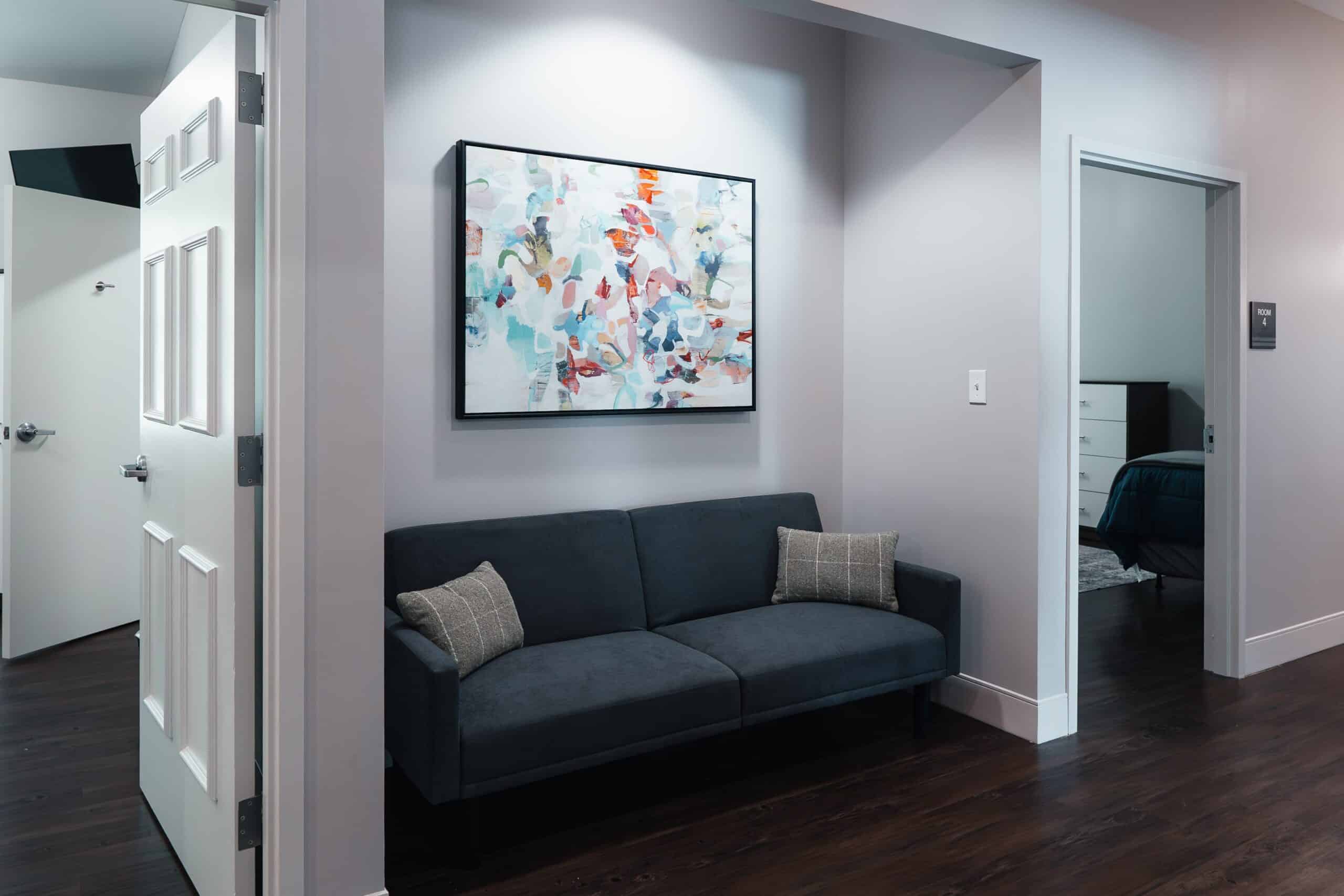
Tour Our Detox and Residential Treatment Center in Georgia


Does Angle Health Cover Drug and Alcohol Rehab?
Angle’s member materials focus on helping people understand their benefits, find care, and use the plan, and its Care Team can explain what a given plan includes. The specific coverage, though, is set in your employer’s plan design. Look for three things in your Summary of Benefits and Coverage or full plan document:
- Substance use disorder benefits: Whether inpatient and outpatient substance use treatment are covered, and under what cost sharing.
- Prior authorization: HealthCare.gov defines it as approval from a plan that may be required before a service is covered. Ask whether your plan requires it for detox or residential treatment, and who submits the request. An approval is not a promise of payment.
- Out-of-network rules: Whether the plan pays anything for care outside its network, and how much.
Plans also judge medical necessity, whether a level of care fits a person’s needs. Clinicians use the ASAM Criteria, a framework for matching people to the right intensity of addiction care, to make that case. Detox and residential treatment are often reviewed separately, and a plan may approve one before the next. Medication can be part of care at any level.
Medication-assisted treatment
For opioid use disorder, SAMHSA lists buprenorphine and naltrexone among the FDA-approved medications, and plans may cover them under the pharmacy benefit or, for injections given in a clinic, the medical benefit, sometimes with their own approval rules. Peachtree Detox & Residential offers Suboxone, Sublocade, Vivitrol, and naltrexone through its medication-assisted treatment program, and our medical team decides with each person whether one fits.
Find the Network Name on Your Angle Card
Angle does not use one national network everywhere. Its provider directory lists several, including Cigna PPO, Aetna, First Health, and PHCS PPO, along with regional networks in other parts of the country. Which one you have depends on your employer’s plan, and it is printed on your card. Two people at two different Georgia businesses could both carry Angle and still have different networks.
That detail decides whether a treatment program is in-network for you. Most of these are PPO networks. HealthCare.gov describes a PPO as a plan where you pay less with in-network providers and can use out-of-network providers without a referral for an additional cost. Out-of-network care usually means a larger share of the bill and sometimes a bill for the difference between what the program charges and what the plan pays.
Because your network is specific to your plan, our admissions team checks how your Angle plan would handle care here instead of giving a blanket answer. It also helps to keep the plan and the network separate in your head. An Angle card with a Cigna PPO logo uses Cigna’s network, but it is not the same as Cigna rehab coverage bought from Cigna itself. The network on the card tells you where you are in-network; the Angle plan document tells you what is covered.
Using Angle’s Care Team
One real advantage of an Angle plan is that members have a dedicated Care Team, reachable by phone or by chat in the Angle app, whose job is to help people understand benefits and find care. For someone trying to arrange treatment quickly, that is a useful first call. A short list of questions helps:
- Coverage: Does my plan cover inpatient detox and residential treatment for substance use, and what will I owe for each?
- Approval: Is prior authorization required, who submits it, and how long does a decision usually take?
- Network: Which network does my plan use, and does it pay anything for out-of-network programs?
- Medication: How are buprenorphine or naltrexone covered under my pharmacy benefit?
Then send your details through our confidential insurance verification form, and our admissions team will contact the plan as well. If a request is turned down, HealthCare.gov explains that you can file an internal appeal within 180 days, and a letter from the treating clinician often helps. A benefits check gives you an estimate, and the final amount depends on the care provided, the length of the stay, and the other factors that shape how much detox costs.
Treatment at Peachtree Detox & Residential
For people whose bodies depend on alcohol, benzodiazepines, or opioids, the first days off the substance are where medical supervision matters most. Alcohol and sedative withdrawal can bring seizures, and opioid withdrawal is miserable enough that people often go back to using at a dose their body can no longer handle. Our medical team monitors withdrawal on the unit and treats symptoms as they come.
After detox, residential treatment continues on the same campus, with weekly individual therapy with a master’s-level therapist, cognitive behavioral therapy, dialectical behavior therapy, trauma-informed therapy, family therapy, and AA, NA, and SMART Recovery meetings. We are in Fayetteville, close to Peachtree City, Tyrone, and Newnan, and about 30 minutes south of Hartsfield-Jackson for anyone flying in.
Check Your Angle Health Benefits With Our Team
Working for a small business can mean everyone knows everyone, and that can make asking about treatment feel exposed. A call to our team is confidential, and you do not need to go through your employer to find out what your plan covers. Reach us through the admissions page with your Angle card nearby, whether you are calling for yourself or for a family member on your plan. We will check your benefits, explain how care here would be billed, and give you a cost estimate. If the plan will not pay for treatment here, we will tell you plainly and go over private-pay arrangements and other options.
FAQs About Angle Health Rehab Coverage for Detox & Residential Treatment
Yes, it is employer-sponsored health coverage. Angle offers level-funded plans to small and midsize employers. According to Angle, its plans are administered by Adrem Administrators in most states, and in Utah they are offered by Balanced Insurance Company of Utah. Your card and plan documents show exactly how your plan is set up.
Many employer plans include inpatient and residential substance use treatment, but with a level-funded plan the details come from your employer’s plan design. Check your Summary of Benefits and Coverage, ask Angle’s Care Team about prior authorization and out-of-network rules, or let our admissions team run a benefits check for you.
Checking your benefits with the plan or with our admissions team does not require going through your employer, and privacy rules limit what a health plan can share with an employer. Federal rules under 42 CFR Part 2 add extra protection to substance use treatment records, though they do allow certain disclosures, such as for payment, with your consent. If you have questions about what a claim or a leave of absence might involve, ask us and the plan directly.
Sources
- American Society of Addiction Medicine. (n.d.). The ASAM criteria. Retrieved from: https://www.asam.org/asam-criteria. Accessed on November 14, 2026.
- Centers for Medicare & Medicaid Services. (n.d.). The Mental Health Parity and Addiction Equity Act (MHPAEA). Retrieved from: https://www.cms.gov/marketplace/private-health-insurance/mental-health-parity-addiction-equity. Accessed on November 14, 2026.
- HealthCare.gov. (n.d.). Health insurance plan & network types: HMOs, PPOs, and more. Retrieved from: https://www.healthcare.gov/choose-a-plan/plan-types/. Accessed on November 14, 2026.
- HealthCare.gov. (n.d.). Internal appeals. Retrieved from: https://www.healthcare.gov/appeal-insurance-company-decision/internal-appeals/. Accessed on November 14, 2026.
- HealthCare.gov. (n.d.). Prior authorization. Retrieved from: https://www.healthcare.gov/glossary/prior-authorization/. Accessed on November 14, 2026.
- Office of the Federal Register. (n.d.). 42 CFR Part 2: Confidentiality of substance use disorder patient records. Electronic Code of Federal Regulations. Retrieved from: https://www.ecfr.gov/current/title-42/chapter-I/subchapter-A/part-2. Accessed on November 14, 2026.
- Substance Abuse and Mental Health Services Administration. (n.d.). Treatment options for substance use disorder. Retrieved from: https://www.samhsa.gov/substance-use/treatment/options. Accessed on November 14, 2026.
Overview
- Who Angle serves: Angle Health offers level-funded health plans to small and midsize employers, managed through an app and a dedicated Care Team.
- Who runs the plan: Angle says its employer plans are administered by Adrem Administrators in most states, and offered by Balanced Insurance Company of Utah in Utah.
- Your network varies: Angle plans use different provider networks, such as Cigna PPO, Aetna, First Health, or PHCS. The one on your card is the one that counts.
- Benefits depend on the employer: In a level-funded plan, the employer’s plan document spells out what substance use treatment is covered and how.
- We check it with you: Our admissions team can review your Angle plan for care at Peachtree Detox & Residential and give you a cost estimate before admission.